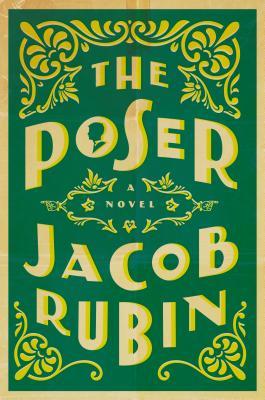
Today I'll be sharing a great new release with you - The Poser by Jacob Rubin! Read on for more information about the book, the author, a Q&A with Jacob, and don't forget to enter the giveaway to win a copy of your own!
The Poser
Author: Jacob Rubin
Genre: Fiction/Comic Fiction
Release Date: March 17, 2015
Publisher: Viking
Description:
A hilarious and dazzling debut novel about a master impressionist at risk of losing his true self
All his life, Giovanni Bernini has possessed an uncanny gift: he can
imitate anyone he meets. Honed by his mother at a young age, the talent
catapults him from small-town obscurity to stardom. As Giovanni
describes it, “No one’s disguise is perfect. There is in every person,
no matter how graceful, a seam, a thread curling out of them. . . . When
pulled by the right hands, it will unravel the person entire.” As his
fame grows, Giovanni encounters a beautiful and enigmatic stage singer,
Lucy Starlight—the only person whose thread he cannot find—and becomes
increasingly trapped inside his many poses. Ultimately, he must assume
the one identity he has never been able to master: his own.
In the vein of Jonathan Lethem’s and Kevin Wilson’s playful surrealism, Jacob Rubin’s The Poser
is the debut of a major literary voice, a masterfully written, deeply
original comic novel, and the moving story of a man who must risk
everything for the chance to save his life and know true love.
Praise:
"Witty, inventive . . . immensely entertaining . . . well-sculpted." —Publishers Weekly
“Zany.”—Booklist
The Poser is smart and grand and funny, a wonderful fable. Mr. Rubin is a great hope for comic fiction in the 21st
century. He’s got the spirit and the ear.”
—Sam Lipsyte,
New York Times bestselling author of The Ask
“Jacob Rubin writes with more vitality, drive, and vision than any young writer I’ve seen in ten years.” —Barry Hannah
“With twists and snap and more than its share of vaudevillian flair,
The Poser is often-dazzling, a high-wire entertainment about
entertainment. Jacob Rubin is a first-rate comic writer, and somehow,
don’t ask me how, he's crafted a hummingly smooth, aching look at why we
perform, loneliness, and the nature of self.”
—Charles Bock, New York Times bestselling author of Beautiful Children
“The Poser seduces with its imaginative energy, the sheer wit and
reach of its invention, but is propelled at its core by a deeply human
generosity to its characters—their fierce and confused and fragile
hearts.” —Leslie Jamison, New York Times bestselling author of The Empathy Exams
“Jacob
Rubin has, to borrow a term from his wondrous debut novel about the
world’s greatest impressionist, deftly unraveled the ‘thread’ of his
protagonist and impersonated a writer twenty
years his senior. The Poser is a rollicking picaresque that is also a surprisingly affecting meditation on authenticity and loneliness.”
—Teddy Wayne, Whiting Writers’ Award-winning author of The Love Song of Jonny Valentine
“The liveliest prose and most ebullient voice in fiction I’ve read in
some time. Full of rich, odd, humorously soulful, and tortured souls who
yearn for – well, they don’t often know, even if they think they do,
but they want it. It’s a romp, this novel, as
if Dickens spawned Stanley Elkin and the Pynchon of The Crying of Lot 49, yet the voice is Rubin’s own. Masterful prose, full of kinetic energy.”
—Brad Watson, author of the National Book Award finalist The Heaven of Mercury and PEN/Faulkner Award finalist Aliens in the Prime of Their Lives
“I yawped—because when you read a book as exquisite as
The Poser, you yawp. Have you ever met a character like Giovanni
Bernini? My heart breaks even now. With astonishing control, Mr. Rubin
has created the perfect comic noir tragedy of mimicry and betrayal, of
great love and greater loss. Bernini is one
of fiction’s great ciphers and his parallel universe is such a good
imitation of our universe I can no longer distinguish which is which.
This is a novel that will be loved and admired for years to come.”
–Reif Larsen,
New York Times bestselling author of The Selected Works of T.S. Spivet and
I Am Radar
“Jacob Rubin’s
The Poser is a tour de force of voice, a genius act of
ventriloquism, a terrific novel. From the opening you’ll be hooked, as I
was, and you’ll love it all the way through.” —Tom Franklin,
New York Times bestselling author of Crooked Letter, Crooked Letter
Giovanni Bernini, The Poser’s protagonist, is known as the World’s Greatest Impressionist. He’s born with the uncanny ability to imitate anyone he meets instantaneously. Throughout the literary spectrum, plenty of stories have been written about performers or performing, but not impressionists specifically. How did you conjure up such an interesting character?
The Poser began, oddly enough, in the trash. Years ago I was working on a not very good short story about a man who wakes up in a woman’s apartment after a one-night stand. Remembering little of the night before, he begins to root around in her garbage for clues. One of the items he finds was, to my surprise, a black-and-white photo of a famed impressionist, a man who could famously imitate anyone he met. As I soon discovered, I was much more interested in this unexpected performer than I was in the guy who discovered him. I scrapped the story right then and wrote another one, very quickly, about this character Giovanni Bernini. After many years, it became The Poser.
You have experience as a performer—both as a juggler for hire and as the lead rapper of the hip-hop group Witness Protection Program, opening for groups like Jurassic Five and Blackalicious, to name a few. How has your background as a performer influenced the creation of Giovanni Bernini?
I can’t seem to get away from performance, in life or in writing. Personae, masks, fraudulence, disguise—all have fascinated me for as long as I can remember. I think a lot about that Picasso line: that art is a “lie that tells the truth.” It seems to me this paradox can obtain in life, too. Like, I once read an article in the Times about a survivor of 9/11, a woman who had been in the south tower when the planes hit. After the tragedy, she organized these legendary support groups. They were these deeply cathartic events, arranged with great thought and care. Survivors and relatives of victims depended on her entirely, so strong was her empathy. Only later did it come out that this woman hadn’t been in the towers at all—she made the whole thing up. I find such behavior deeply disturbing, of course, but fascinating, too. The lie, for this woman at least, clearly felt like an emotional truth.
I did stand-up comedy for a little while, and I think the status of the stand-up comedian reflects a similar paradox: instead of a lie that tells the truth, maybe a stand-up states a truth so serious it has to be packaged as a joke. The stage offers a kind of loophole, a free zone in which what would otherwise be punishably inappropriate can be aired with impunity, even to applause. It’s what performance offers in general, I think: this magical, cordoned-off space where people can lie, hurl abuse, decompensate, and the crowd hoorahs! In The Poser, I wanted to explore a character who finds that his previously outrageous behavior is celebrated simply because it’s put on the stage.
A man with a million personas, Giovanni seemingly can be anyone except himself and at one point in the story undergoes psychoanalysis. Coming from a family of psychiatrists yourself, you must have some insight into analysis and some rather interesting stories, to boot. Will you talk briefly about growing up among psychoanalysts and how that may have shaped Giovanni as a character and the story as a whole?
My grandfather, Theodore Isaac Rubin, was a very famous psychiatrist in the 60s, 70s, and 80s. He appeared regularly on the Phil Donoghue show and wrote many bestselling novels and self-help books, one of which was turned into an Oscar-nominated movie, David and Lisa. Largely because of his influence, my father, aunt, and uncle all went on to become shrinks. Suffice it to say, there is no dearth of introspection at our family get-togethers. (Somewhat notoriously, I informed a classmate of mine in the third grade that he was “projecting”; I am still living this down.) And yet I also wanted to show how beneficial therapy can be. I think portrayals of analysis in books and movies are often pretty lazy, framing it as this ridiculous or masturbatory exercise. I wanted to show that there is true empathy in it – a kind of warm detachment – that can really help people.
The Poser is told from Giovanni’s perspective, at a point in his life where he’s looking back at everything that’s befallen him. What compelled you to use first-person confession as the mode for telling the story?
The enjoinder to “show don’t tell” is important for every young writer to hear, and yet so many of my favorite books wholly disregard it. Notes from the Underground, for instance, or Walker Percy’s The Moviegoer, the novels of Robertson Davies and Stanley Elkin. Everyone knows novels can’t compete with movies or video games for sheer sensory onslaught, but books, for my money, capture better than any other media the interiority of experience, the “music of someone’s intelligence,” as Richard Ford once put it. My favorite books promise just this kind of intimate—and for that reason, often scandalous—experience. Like, Lolita or Denis Johnson’s Jesus’s Son. You open those books, and you’re encountering this presence, this personality talking about something it shouldn’t have done in a voice unlike any you’ve ever heard. My favorite books, probably for that reason, feel like a secret, and you feel slightly cheated when you find out someone else read it. You’re like, “Hands off. She told that to me and no one else.”
Thematically, I thought the first-person narrative was necessary for The Poser as it’s about a man struggling to find himself, which he does, in the end, by telling the story. I also liked the tension of having someone act a certain way, as a performer or fraud, while narrating his often discordant internal experience. He says one thing, but thinks another. This is something I think fiction can do particularly well.
Giovanni’s world is noir-ish, vaudevillian, even a bit surreal. The story is set in an imaginary country that somewhat resembles America of the 1950s and 60s. What was your thought process in setting the story in a parallel, fable-like world? Did you do any research to flesh out its wonderful detail?
I knew I was taking a risk in setting the book in an imaginary place, a parallel America of the 50s and 60s, and yet it felt necessary for the kind of book I was hoping to write. The Poser, as I see it, is about Giovanni’s attempt to become a real person; it felt right that the landscape, too, might strain to be real, flickering between the evoked and the shadowy. I did do research about the corresponding time in America. Stuff about clothes, some slang, etc. I used as models for the noir prose style novels by favorites like Jim Thompson and Raymond Chandler.
I can’t seem to escape the surreal. In visual art, it’s always been my favorite: Giacometti’s sculptures, for instance, or the paintings of Paul Klee. I think I’ve always aspired to whatever the prose equivalent of such a way of seeing would be. For me, it is rare that when meeting a person I note what color nail polish she’s wearing or which kind of ankle boot (this can be very embarrassing, mind you, for someone meant to be observant). Encountering a person can be a pretty damn surreal experience, much more like meeting a Giacometti or a Klee. I think the same is true of places. Just walking around and seeing people yammering on their cellphones or driving around in these motorized chrome bubbles—we live in a sci-fi movie! My agent, Jin Auh, once relayed a line the author George Garrett had about Fellini’s movies. He called them “science fiction set in the past.” I loved that. I think that’s what I’m trying to write.
Bestselling author Sam Lipsyte praised you as “a great hope for comic fiction in the 21st century.” Did you set out to write a humorous book? Were there any books or authors—comedic or otherwise—who inspired you while writing The Poser?
Sam Lipsyte has made me laugh so many times, so I was on cloud nine when I found out he enjoyed the book. I certainly hope the novel’s funny. My old teacher Barry Hannah used to say that books should offer “deep entertainment”; the unkillable ham in me can’t seem to let go of the second word. All of my favorite contemporary writers make me laugh: Jennifer Egan, Jonathan Lethem, Sam Lipsyte, Barry. Even very dark, supposedly depressing, classics are secretly knee-slappers. I’m thinking of writers like Knut Hamsun, Thomas Bernhard, Samuel Beckett, and Herman Melville. I read Paul Auster’s introduction to Hunger, in which Auster talks about how dark and miserable the book is (all of which is true, of course), but I also thought, it’s hilarious! The truly tragic is the funniest stuff there is! The fact that we live on a spinning ball in an endless void, or that we possess a seemingly infinite consciousness but will all die. It’s just so absurd. I think laugher is the sound of someone accepting their powerlessness and through that acceptance briefly somehow transcending it. And it shouldn’t ever be explained. And I now ruined it forever.
Besides working as a novelist, a magician, and a rapper, you also write screenplays. In fact, Times Square, a script you co-wrote with Taylor Materne, was recently optioned by Focus Features. In your opinion, what’s the biggest difference between writing a novel and a script, and do you prefer writing one form over the other?
I’ve found the two to be very different. In film, structure is king, so you really have to work out the entire plot as much as you can before setting off to write. It helps a lot to work with someone else to figure out what needs to happen when. Of course, you often end up changing nearly everything anyway, but it’s almost more like assembling a watch or engine, some device that has to meet company-mandated specs. Fiction writing, for me, is a much more unwieldy, inefficient, foolhardy, and reliably meaningful experience. That said, I’ve always enjoyed writing dialogue, and the script stuff is a fun opportunity to pen snappy exchanges. In movie writing, you get to put down things like, “NO WAY OUT. The green creature on his heels, he GRABS the duffel bag and – screw it – LEAPS OFF the roof over the sea wall to the CHURNING WATERS of the GULF of MEXICO.”
The Poser is your debut novel. Is there a second in the works? If so, could you talk a bit about it? If not, would you mind divulging what other creative projects you’re currently working on?
There is a lengthy word file in my laptop that I hesitate to call a second novel, but perhaps it will be one day! It is too early to talk about it, but I hope it will be funny.
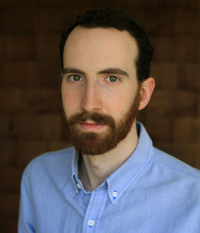
Jacob Rubin’s writing has appeared in the anthology Best New American Voices, www.newyorker.com,
New York magazine, Slate, n+1, and The New Republic. Times Square, a
screenplay he co-wrote, was recently acquired by Focus Features. He
lives in New York. (Author photo and biography taken from Goodreads)
Author Links:
Giveaway: (1) Hardcover copy of The Poser - Open to US only!
*A huge thanks to the fantastic people at Viking for providing a copy of the book for my giveaway!*
 The Hike


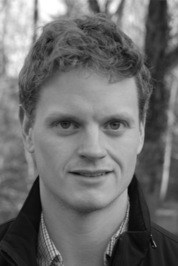 Drew Magary is a correspondent for GQ and a columnist for Deadspin. He is the author of the memoir Someone Could Get Hurt and the novels The Postmortal and The Hike (out 8/2). His writing has appeared in Maxim, New York magazine, The Atlantic, Bon Appétit, The Huffington Post, the Awl, Gawker, Penthouse, Playboy, Rolling Stone, and on Comedy Central, NPR, NBC, ESPN, and more. He lives in Maryland with his wife and three kids, and is a Chopped champion.