I
am thrilled to be hosting a spot on the REBEL DAUGHTER by Lori Banov Kaufmann Blog
Tour hosted by Rockstar Book Tours. Check out my post and make sure to enter the
giveaway!
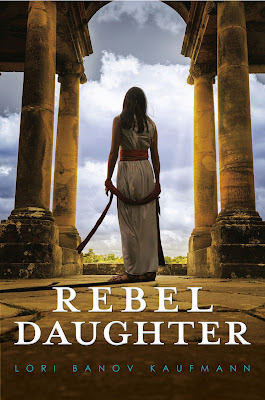
Author: Lori Banov Kaufmann
Release Date: February 9, 2021
Publisher: Delacorte Press
Formats: Hardcover, eBook, Audiobook
Pages: 400
Find it: Goodreads, Amazon, Kindle, Audible, B&N, iBooks, Kobo, TBD, Bookshop.org
Description:
A
young woman survives the unthinkable in this tale of family, love, and
resilience, set against the destruction of Jerusalem in 70 CE.
Esther dreams of so much more than the marriage her parents have arranged to a prosperous silversmith. Always curious and eager to explore, she must accept the burden of being the dutiful daughter. Yet she is torn between her family responsibilities and her own desires; she longs for the handsome Jacob, even though he treats her like a child, and is confused by her attraction to the Roman freedman Tiberius, a man who should be her sworn enemy.
Meanwhile, the growing turmoil threatens to tear apart not only her beloved city, Jerusalem, but also her own family. As the streets turn into a bloody battleground between rebels and Romans, Esther’s journey becomes one of survival. She remains fiercely devoted to her family, and braves famine, siege, and slavery to protect those she loves.
This emotional and impassioned saga, based on real characters and meticulous research, seamlessly blends the fascinating story of the Jewish people with a timeless protagonist determined to take charge of her own life against all odds.
Based on an incredible true story!
AUTHOR NOTE AND HISTORICAL OVERVIEW:
Additional
back matter includes an Author Note, which gives historical context and
explains author’s inspiration for the book. Included as well is an historical
overview by an eminent scholar of the period.
CHARACTER DRIVEN HISTORICAL FICTION:
Fans
of THE RED TENT and THE DOVEKEEPERS will appreciate this incredibly detailed
and accurate depiction of historical events, woven within a richly told and
emotionally complex story of growth.
STRONG EMPOWERED FEMALE HEROINE:
Despite
the constraints of society and the savagery of war, Esther is an independent
thinker exploring her identity and her faith—and showing unimaginable strength
in the face of trauma.
HISTORY BROUGHT TO LIFE:
The
destruction of the Temple in 70 CE by the Romans is a crucial part of the
Jewish story, but it’s often lost amid more well known historical legends. The
depiction of Esther’s faith is realistic and moving to a modern audience.
FAITH:
The
role of faith and family obligation is explored in depth.
The story will resonate with people who love Biblical history, Israel and stories about faith, courage and family bonds.
REVIEWS:
“Esther’s remarkable, mysterious, and meticulously researched story is one that demands to be told.”—Kirkus Reviews
“The writing is clear, smooth, and accessible. An engaging story for historical fiction fans.”—School Library Journal
"Riveting!" Allegra Goodman, author The Cookbook Collector
Selected by the Junior Library Guild
Book
Trailer:

Q&A
1.Which
writer has had the greatest influence on you?
My grandmother. Although she was never published, she always wrote short stories and essays. Her passion for books and reverence for the written word had a tremendous influence on me.
2. Advice?
Even though I always dreamed of becoming an author, I never found a way to fit it into my already bursting-at-the-seams life with 4 kids and a busy career. Finding thirty minutes of "quiet time" to write seemed about as realistic as running a marathon.
At the age of 50, I figured it was either now or never. It took me another ten years to finish so I'm hardly the best person to ask for advice! I wrote in those stolen moments between work and family, carpools and laundry. But the thing is - those stolen moments eventually add up.
I see myself more as a cautionary tale than an inspiration! ! But I suppose, if I can do it, you can too. It's never too late.
So my
advice? START!!
And my next piece of advice? Don't give up, finish! Some writers sprint to the finish line and some (like me) hobble. But if you keep going, you'll eventually get there.
3. Favorite childhood books?
The Phantom Tollbooth
The Happy
Hollisters - a mystery series for children. We used to get two every
month in the mail (remember what that is?) and my brother and I used to
fight over who got to read them first. I also remember pouring over the
biographies in the children's section of the library. I don't remember any of
the books but I still feel the distinctive ink and paper smell of that
neighborhood library and the blast of cold air from the noisy air conditioner.
4. Favorite book?
An
impossible question! There are so many outstanding books and incredible writers
working today.
5. Favorite
movies?
I love movies that take me back in time to exciting historical events, shown through the eyes of someone there. Movies like Saving Private Ryan, Schindler's List, and Exodus to name a few.
6.
Becoming a writer
Like most avid readers, I've always had romantic notions of being a writer. Struck by the muse, writing into the wee hours of the night and all that.....Being a writer always seemed more like a fantasy than a realistic career path.
So I never
actually decided to become e a writer. I did decide, though, to write this
particular 2,000 year-old- love story. When I heard about the gravestone of
Claudia Aster (on whose life Rebel Daughter is based), I was intrigued. I
wanted to know more and slowly - very, very slowly since it took me 10 years! -
I wrote her story. It still feels slightly pretentious to call myself a writer
but maybe when I see the published book, I'll feel like I earned the title!
7. Where
do you write?
My corner desk in the attic, surrounded by piles of books, bills, recipes and other unruly papers that refuse to be tamed.
8. Book
character most like me
Even though I love to read about (and identify with) bold, adventurous heroines who change the world, I'm probably most like Elizabeth Strout's grumpy Olive Kitteridge or Agatha Christie's stubborn old Miss Marple.
9. Music?
Any classic Rock or old Country Music. When I'm sure my kids are at a safe distance away (like in a foreign country), I've been known to crank up the Dolly Parton and dance around the living room!
10. Drink?
Green tea with fresh mint if I'm feeling like being nice to myself and instant decaf coffee if not
11. Guilty
pleasure book?
I never feel guilty about the books I’ve read, only about the ones I haven’t.
12. REBEL
DAUGHTER takes us back in history to 70 CE, a tumultuous time for the
Jewish community in Jerusalem. What inspired you to write about this particular
period of time?
I didn’t set out to write about this
period. I fell into it by accident! I was inspired to write Esther’s story
after learning about the discovery of her two-thousand year-old gravestone, an
exciting and important archaeological find. It was the mystery behind the stone
that drew me in and made me want to know more. Who was she? How did a girl from
Jerusalem become a Roman woman buried in Italy?
And from
there, I began to research the time period. I was stunned that I knew so little
about one of the most formative eras in human history. It is a fascinating
period that has many parallels with our world today, especially the civil
discord and religious fanaticism.
13. You
tell the story of Esther, the daughter of a priest. Esther is brave, bold, and
unafraid in spite of the challenges she faces as a young woman, including an
impending marriage to a man she does not love. Did you face any
challenges in creating a character that was historically accurate yet infused
with the ability to see beyond what was expected of her?
Yes! That’s
a great question because of course girls in the first-century didn’t have the
freedom we’re used to today. Sexism was not only alive and well, it was
considered necessary for the proper functioning of society. And I was
absolutely committed to writing a book that was historically accurate. I felt
an obligation not only to the real historical people whose story I was telling,
but also to my readers.
So the
challenge was how to portray a bright, curious young woman who lived thousands
of years ago. For example, Esther had a thirst for knowledge, an innate human
trait. She wouldn’t have gone to school, of course, but scholars have
determined that there were women who were literate in first-century Jerusalem.
So she probably learned to read and write at home. And in Esther’s case, from
her father. I had to show how Esther navigated the very real gender barriers of
the time.
14. You
explore the daily life in Jerusalem in great detail – from chores and religious
practices to the struggles between the Jews and the Romans. Can you share a bit
about your research process?
I wouldn’t
call it a “process”! It was more like an obsession. I had a sense of obligation
to portray the time and setting as accurately as possible and a fanatic
attention to detail. I read literally hundreds of books, dissertations and
conference proceedings. I also worked closely with the leading historians of
this era. Luckily, I live in Israel and had access to the artifacts at the
Israel Museum, the archaeological sites all over the country, and the
world-class scholars at Hebrew University and Tel Aviv University. My “process”
is why this book took me 10 years to write! In retrospect, I realize that I
went completely overboard with the research but it truly was a labor of love.
15. What
were some interesting facts you discovered that did not make it into the book?
How much
time do you have? There are so many! My first draft of the book was over 1000
pages because of all the “interesting facts”. My editor insisted that I
couldn’t describe everything – how face cream was made from sheep fat or bread
baked in clay ovens.
16. What
do you hope readers take away from REBEL DAUGHTER?
I hope
readers are taken away! I want them to have the feeling of going back in
time. I want them to enjoy the trip. That’s my main hope. And if the experience
makes them see our own world in a new light, then that’s a bonus.

Esther held her breath as the priest stroked the lamb and whispered into its ears. It was a moment in and out of time, between life and death, between creation and destruction. The fulfillment of God’s sacred commandment.
Ever since she’d been little, Esther had climbed the staircase to the balcony above the Gates of Nicanor to watch the Tamid ceremony. From here, she had an unobstructed view of the bloodstained altar blackened with ash. The guard, a portly man with a large key dangling from his belt, was a friend of her father’s, and he winked when he saw her. They both knew that at fourteen, she should have been down below with the crowd in the Temple courtyard.
Another priest raised his knife. The blade, honed to slice a single hair in midair, glinted in the rising sun. The lamb bleated and its legs twitched. Esther wondered if the lamb knew its fate. The day before, it had probably nuzzled its face in its mother’s warm, soft belly. Now, with a smooth, swift stroke, the priest cut its throat.
Esther tucked unruly strands of her long hair under her scarf. Sometimes she wished she could tuck her whole self underneath it. Almost overnight, she had gone from being invisible to attracting attention she didn’t want. Her sister-in-law Miriam said it was because of her eyes; they were even darker than her hair, the color of carob pods left out too long in the sun, with a ring of gold around her pupils.
But Miriam was wrong. Men weren’t looking at her eyes, or even her face. It was her body they were looking at, a body with curves that she hardly recognized.
Esther immediately spotted her father, Hanan, in a line of priests carrying jugs of olive oil, pots of incense, and baskets of flour toward the altar. Each wore a white robe covered with a vest woven with purple, scarlet, and blue threads. Their heads were wrapped with silk turbans, and their feet were bare. He wouldn’t look up—his every movement was prescribed—but he knew, of course, that she was there.
Even though she had three brothers, Esther was the one he’d asked to walk home with him and carry their share of meat left over from the offerings.
After the Tamid, Esther followed her father through the throng of people on the Temple Mount. He lifted the hem of his robe, sidestepping the sludge on the ground. She held the reed basket close to her chest, hoping the street dogs wouldn’t smell the singed lamb necks inside.
People moved aside and bowed their heads when her father passed. Hanan was a senior priest with an office in the Royal Portico, where there were one hundred and sixty-two marble columns so large that even when Esther and her brothers joined hands, they couldn’t encircle one.
Esther saw them first—Roman soldiers. One, with an iron helmet atop his head and a short red skirt, stuck out his foot. Hanan stumbled and fell to the ground. The soldier planted his muddy boot on her father’s back and held him down as he struggled to get up.
“Look, the Jew is kneeling before us,” he sneered. “Now you’re in the correct position, holy man, to pay homage to the great Roman empire.” He thrust a large wooden shield with a picture of a wild boar into her father’s face. “Kiss it!”
Her father turned away. There was a gash on his forehead, and blood ran down his face.
“Kiss it! I command you!”
Hanan lay motionless. People averted their eyes and scurried away. Her father’s white robe, woven from fine linen imported specially from Alexandria, was covered in filth and dung. His scrolls lay scattered, and his wax tablet had been smashed.
Esther’s eyes widened as two soldiers grabbed her father under his arms and yanked him up. Still, he remained impassive and refused to look at them. They shouted, but he didn’t respond.
“Dirty Jew! You and your scraggly beards and barbaric superstitions! You’d cut your son’s cock, but you won’t kill a pig? Is that right?”
“Let him go!” Esther demanded, dropping the basket and running toward her father. The soldiers laughed.
“Look at the little she-wolf who comes to the rescue!”
One stepped on a scroll while another snatched the basket. A soldier with feathers on his helmet pulled her arms behind her back.
“If he won’t kiss the shield, make him kiss the ass of the ass!” another one said. Laughing, they pushed her father toward a donkey tied to a low branch of a nearby tree.
“You Jews don’t like graven images?” the tall one asked. “You won’t kiss it? Then kiss the real thing instead!”
Esther struggled to break free.
“Kiss the ass and we’ll let her go.”
She sucked in her breath. Kiss it? An unclean ass? Her father wouldn’t do that! He was pure, a priest. God would intervene and strike down these vile tormenters. What was He waiting for?
The donkey, startled by the noise, flung his head back, flapped his large ears, and brayed.
“Stop screeching!” another soldier yelled as he brought the side of his gladius down on the donkey’s neck. “You sound like a woman!”
The animal’s hind leg shot straight back and grazed her father. The soldiers laughed again.
She looked at her father for reassurance, for a sign that this would soon end. She wanted him to stand straight, to break free, to be a warrior like Samson or Gideon and take her home. She willed him to look at her, but he wouldn’t; it was as if he were trying to shield her from his shame.
“What are you waiting for, Jew?”
Esther’s palms were wet with sweat. Hanan took a deep breath and stepped toward the donkey. He bent toward the beast, closed his eyes, and quickly touched his lips to the donkey’s haunches.
The soldiers cheered and gave her a forceful shove. The entertainment was over, and they had already lost interest. Her father grabbed her hand. He limped but still moved so fast that she could hardly feel her feet on the road. She didn’t dare look back to see if the soldiers were following them.
Her father pulled her into the dark alleyway under the arches, below the aqueduct. His face and beard were caked with clumps of mud and dried blood. She wanted him to bring her close and comfort her, but he closed his eyes, and his hands hung by his sides.
“We will forget this ever happened,” he said.
Esther clenched her fists. She hated the Romans. Every last one.

 As
soon as she learned of the discovery of the first-century tombstone that
inspired Rebel Daughter, Lori Banov Kaufmann wanted to know more. She was
captivated by the ancient love story the stone revealed and resolved to bring
it back to life.
As
soon as she learned of the discovery of the first-century tombstone that
inspired Rebel Daughter, Lori Banov Kaufmann wanted to know more. She was
captivated by the ancient love story the stone revealed and resolved to bring
it back to life.Before becoming a full-time writer, Lori was a strategy consultant for high-tech companies. She has an AB from Princeton University and an MBA from the Harvard Business School. She lives in Israel with her husband and four adult children.
Website | Twitter | Instagram | Facebook | Goodreads | Amazon

(2) winners will win a finished copy of REBEL DAUGHTER & Swag - International.
Tour
Schedule:
Week
One:
|
2/1/2021 |
Review |
|
|
2/2/2021 |
Review |
|
|
2/3/2021 |
Review |
|
|
2/4/2021 |
Excerpt |
|
|
2/5/2021 |
Excerpt |
|
|
2/6/2021 |
Review |
Week
Two:
|
2/7/2021 |
Excerpt |
|
|
2/8/2021 |
Excerpt |
|
|
2/9/2021 |
Review |
|
|
2/10/2021 |
Review |
|
|
2/11/2021 |
Review |
|
|
2/12/2021 |
Excerpt |
|
|
2/13/2021 |
Excerpt |
Week
Three:
|
2/14/2021 |
Review |
|
|
2/15/2021 |
Review |
|
|
2/16/2021 |
Review |
|
|
2/17/2021 |
Review |
|
|
2/18/2021 |
Review |
|
|
2/19/2021 |
Review |
|
|
2/20/2021 |
Excerpt |
Week
Four:
|
2/21/2021 |
Review |
|
|
2/22/2021 |
Excerpt |
|
|
2/23/2021 |
Review |
|
|
2/24/2021 |
Review |
|
|
2/25/2021 |
Spotlight |
|
|
2/26/2021 |
Review |