Genre: Adult, Fantasy
Release Date: August 5, 2014
Publisher: Viking Adult
Description:
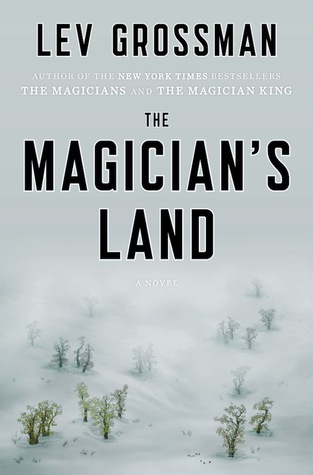
In The Magician’s Land, the stunning conclusion to the New York Times bestselling Magicians trilogy—on-sale from Viking on August 5—Quentin Coldwater has been cast out of Fillory, the secret magical land of his childhood dreams. With nothing left to lose he returns to where his story began, the Brakebills Preparatory College of Magic. But he can’t hide from his past, and it’s not long before it comes looking for him.
Along with Plum, a brilliant young undergraduate with a dark secret of her own, Quentin sets out on a crooked path through a magical demimonde of gray magic and desperate characters. But all roads lead back to Fillory, and his new life takes him to old haunts, like Antarctica, and to buried secrets and old friends he thought were lost forever. He uncovers the key to a sorcery masterwork, a spell that could create magical utopia, a new Fillory—but casting it will set in motion a chain of events that will bring Earth and Fillory crashing together. To save them he will have to risk sacrificing everything.
The Magician’s Land is an intricate thriller, a fantastical epic, and an epic of love and redemption that brings the Magicians trilogy to a magnificent conclusion, confirming it as one of the great achievements in modern fantasy. It’s the story of a boy becoming a man, an apprentice becoming a master, and a broken land finally becoming whole.


A: On some level all the Magicians books are written as a conversation with Lewis and Rowling. It’s a complicated conversation – sometimes it’s affectionate, occasionally it’s rather heated – and it continues in The Magician’s Land. I thought Rowling let Harry off a little easy by never showing him to us at 30. We never really saw him having to deal with his traumatic past – his abusive childhood, his experience of violence and death, his massive world-saving celebrity as a teenager – and struggling to figure out what the rest of his life is about. Those are things Quentin has to do in The Magician’s Land. When you’re a magician, and there’s no ultimate evil to defeat, when you’re not a kid anymore, what is magic for?
As for Lewis, Narnia fans will pick up echoes of The Magician’s Nephew and The Last Battle, the stories of Narnia’s creation and of its destruction. Lewis made a bit of fetish of childhood and innocence: Narnia was a place for children, and when you grow up and get interested in adult things, you lose that special magic. You see that in Peter Pan too – it’s one of the dominant tropes of 20th century fantasy. In The Magician’s Land I wanted to think not just about what you lose when you grow up, but what you might gain. You lose the magic of innocence and wonder, but do you gain a richer, more complex kind of magic?
Q: You come from a family of serious academics. What was their reaction when you chose to write genre fiction rather than something more “literary”?
A: It sounds funny to say it, but writing The Magicians was a serious act of rebellion for me. Coming from the family I do, it was an act of calculated treason. I had to nerve myself up to do it. But I had to – it was the only way I could say what I wanted to say. I couldn’t do anything else.
I think it’s fair to say that reactions were mixed. My mom was cautiously enthusiastic, and my brother and sister have been hugely helpful with the books. But I don’t think my father ever read any of The Magicians books.
Q: The Magicians books have stirred up a lot of controversy among readers. They attack or invert the most sacred conventions of fantasy, and as a result, have divided the fantasy world. Can you speak a bit about this diverse reader response?
A: No question, the Magicians books are polarizing. They’re supposed to be. The same way Neuromancer did with science fiction, and Watchmen did with superhero comics, the Magicians books ask hard questions about fantasy. What kinds of people would really do magic, if it were really, and what would the practice of magic do to them? What would really go on in a school for magic, with a bunch of teenagers in a fairy castle being given supernatural powers? What would happen if you put in all the depression and the violence and the blowjobs and the drinking that Rowling leaves out? What would happen to those kids after
they graduated? What would happen if you sent these kids through the looking glass, into a magical land that was in the grip of a civil war?
These aren’t the kinds of questions everybody wants asked, but that’s how genres evolve. Watchmen was a brutal interrogation of the superhero genre – and it was also the greatest superhero story ever written. You couldn’t write a comic book the same way after Watchmen was published. I’m not saying the Magicians books are the greatest fantasy novels ever written, but they’re asking the same kinds of questions.
Q: What were your major influences from science fiction or fantasy genres? What about more mainstream, literary works? How do you see these manifesting themselves in THE MAGICIAN’S LAND?
A: What got me started writing The Magicians was reading Susanna Clarke’s Jonathan Strange and Mr. Norrell in 2004. There were several novels around that time that did things with fantasy that had never been done before, used it to say things that had never been said before. George R.R. Martin’s books were like that, and so were Neil Gaiman’s, especially American Gods. So were Kelly Link’s. When I read those books, I knew that I had to be a part of whatever they were doing.
I also have a bit of an academic background – I spent a few years in graduate school, and I studied the literary canon, particularly the history of the novel, pretty intensely – and that comes out in the Magicians books too. You can find bits of Proust in them, and Fitzgerald, Woolf, Donne, Joyce, Chaucer, T.S. Eliot. You can find a lot of Evelyn Waugh – Brakebills owes a lot to Hogwarts, but it owes a lot more to the Oxford of Brideshead Revisited. I wanted to see what happens when you take techniques and tropes from literary fiction and transport them, illegally, across genre lines.
Q: As a literary critic, you’ve worked to promote the value and respectability of genre fiction – one year you put George R.R. Martin at the top of Time’s list of books of the year. You did the same with Susanna Clarke and John Green. Does that fit in with what you do as a writer of fiction?
A: In my own nerdy way I’m trying to start a revolution, or maybe I’m just trying to join one that got started without me. It’s a literary revolution, but not the usual kind, where people who are writing difficult, avant garde literature figure out a way to make it even more difficult and avant garde. I’m talking about a revolution of pleasure, where the question of a book’s worth is de-coupled from the question of whether or not it’s hard or unpleasant to read.
Q: If The Magicians, The Magician King, and THE MAGICIAN’S LAND were made into movies or a television series, who would you envision playing Quentin and his friends?
A: The challenge with the Magicians characters is to convey a lot of intelligence, and also to not be overly good-looking. They’re a clever lot, and they’re also very real – they look like real people. Ben Whishaw has probably aged out of the Quentin role, but people mention him to me a lot, and that seems right. Sometimes I pictured specific actors while I was writing – Eliot, for example, I imagine as something like Richard E. Grant in Withnail and I. I often imagine Alice as Thora Birch from Ghost World.
Q: There are a lot of tech references in The Magicians books that would seem more at home in science fiction than fantasy, ie. the origin of magic is described in hacker language. Why did you choose to juxtapose so much tech with magic?
A: I’m very committed to the project of making the Magicians books feel real, and to that end I made a deal with myself: everything that’s real in our world would be real in Quentin’s. And that means including contemporary technology, cell phones and the Internet and so on.
But beyond that, I think the same people who are interested in technology in our world would be drawn to magic if it were real, as much as the Wiccan crowd. Magic is interesting and complicated and powerful the same way technology is, and it requires some of the same mental discipline.
Also, I’m a science fiction writer manqué. I like the way SF writers look at the world. I like to think I write about magic the way good SF writers write about technology.
Q: You have a degree in comparative literature from Harvard but dropped out before getting your Ph.D. from Yale. What made you decide not to become an academic yourself?
A: I can’t even remember what made me decide I wanted to be one in the first place, except that I was unemployed and wanted to read books and talk about them as much as possible. Which I did get to do, and I loved it. But I knew from watching my parents that the life of an academic is not a glamorous one. It is frequently an underpaid and inglorious one, except for the superstars, and it quickly became apparent that I wasn’t going to be one of those. Fortunately I married one instead.
Q: You have an identical twin brother, Austin Grossman, who is also a Harvard grad and successful fantasy novelist. Why do you think you’ve traveled such similar paths professionally? How do you think growing up as twins shaped your writing, respectively?
A: It’s a mystery. I don’t know if twins have much more insight into it than regular people have. Austin was a very successful video game designer in his 20s, whereas I spent most of that decade looking for a career of any kind. But then somehow, for some reason, we re-converged. It happens all the time, not just with our writing. We live on opposite coasts, and only see each other a few times a year, but there’s always some uncanny coincidence in what we’re doing, or wearing, or listening to, or reading.
Though I’m very conscious of the differences in our work too. We’ve read the same things, seen the same movies, and watched the same shows, so our cultural points of reference are all the same. We know all the same words. But he writes only in the first person, and I only write in the third person. We use the same raw materials to construct very different stories.
Q. Over the past decade, fantasy has become more accepted in mainstream and literary circles. What do you think has changed and where do you see the genre going? Does fantasy get the respect it deserves among scholars?
A. A lot has changed for fantasy in the last decade or so. The 1990's were all about science fiction—Star Wars, Star Trek, the Matrix—but something changed around the turn of the millennium. After 2001 the popular imagination became focused on fantasy -- Harry Potter
and Twilight and The Lord of the Rings. En masse, we turned to fantasy for something we needed and weren't finding elsewhere. What that is, it’s hard to say, but it’s led to a glorious resurgence of the genre. Fantasy is evolving and maturing. It’s definitely not just for kids anymore. Writers like Neil Gaiman, Susanna Clarke, China Mieville, George RR Martin and Kelly Link are making it more complex and interesting and sophisticated and powerful than it ever was before.
But no, as far as I can tell, it still gets very little respect from the academy.
Q: What’s your favorite part of writing outside of reality?
A: What makes fantasy interesting to me is what it can’t do. Magic doesn’t solve everybody’s problems. You have characters who are capable of drawing energy from invisible sources, making it crackle from their fingers, performing miracles. But when they’re done, they’re still who they are. Life is still life. Magic doesn't change relationships. It doesn’t fix your neuroses. Those basic problems are still what they were, and they have to be solved the old-fashioned way, just like in any other novel.


The wonderful people at Viking are allowing me to give away (1) hardcover copy of The Magician's Land to a lucky reader! Open to US only!